Showing posts with label Buddhism. Show all posts

Tuesday, June 22, 2010

Wheel of Time

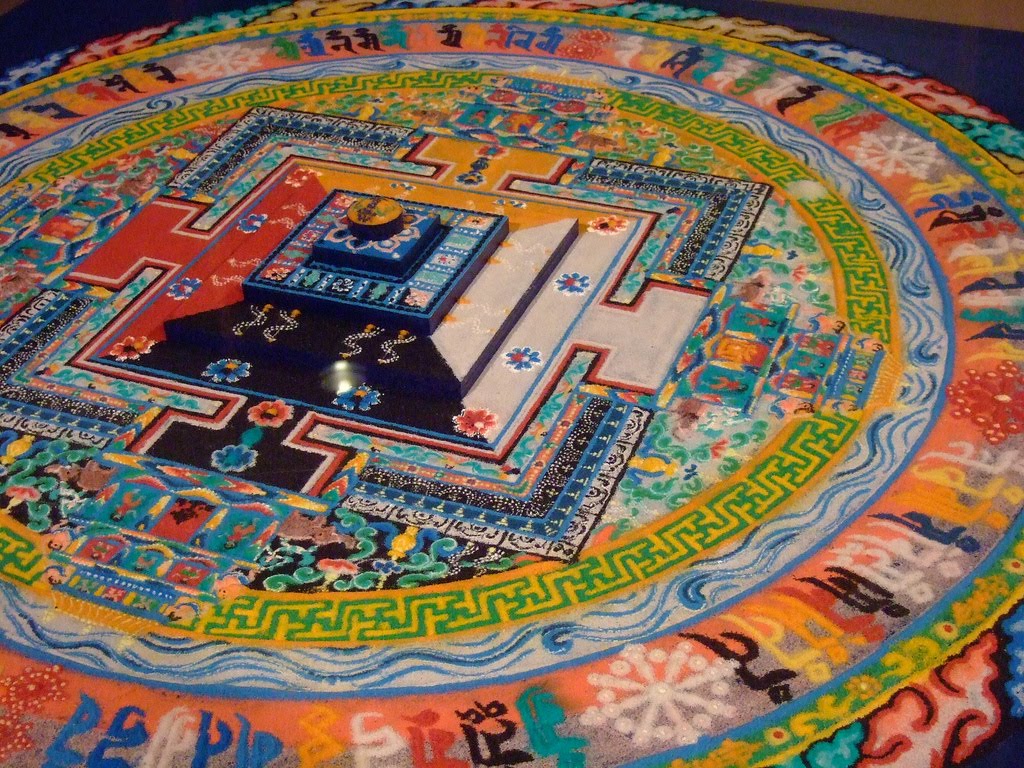
I recently rented a documentary on Buddhist practices and rituals by Werner Herzog entitled Wheel of Time. The film focused on the Kālacakra Initiation which took place in Bodhgaya, India in 2002, the place where the Buddha attained enlightenment. Kālacakra centers around the building of a beautiful sand mandala which is made entirely by hand by skilled monks. Here is a chart breakdown of the elements in a Kālacakra mandala and a video depicting the 3D image that this 2D image represents.

[Image of a sand mandala, taken from We Can Change the World.]

I found the Kālacakra Initiation, which initiates practitioners into Vajrayana Buddhism, fascinating although I'm unfamiliar with their rituals and, quite honestly, Buddhism altogether. Yet hundreds of thousands of Buddhists came not only to get initiated into the Vajrayana practices but to see the Dalai Lama who leads the initiates through the ceremony. This ritual is meant to activate the seed of enlightenment and help the initiate onto the path towards buddhahood. Some came by prostrating themselves the entire trip. One such pilgrim, Lama Lhundup Woeser, traveled in prostration for over 3,000 miles which took him three and a half years to complete. Word spread quickly of his journey although he didn't want any attention, and because of his dialect the film crew needed two different translators because he came from such a remote village. Monks held theological debates while others prostrated themselves towards the Sri Maha Bodhi, the bodhi tree claimed to be the descendant of the tree under which the Buddha attained enlightenment. Many of those prostrating towards the tree had a goal of prostrating over 100,000 times which usually takes them up to 6 weeks.

It is a beautiful film and I highly recommend it to anyone interested in Buddhism. It doesn't get into much detail but it is worth checking out. But through all the rituals and chants the thing which moved me the most were the human moments. Watching thousands of people chanting and meditating you almost forget that they still feel pain and suffering, love and compassion. There was one scene were it looked like the monks were throwing out food or gifts out into the crowd (it looked like candy bars) and people were scrambling like mad. Another scene showed monks rushing to get the chance to work in the kitchen to feed their brothers. And as the Dalai Lama announced he was too ill to lead the main initiation rites announcing the cancellation and postponing of the Kālacakra initiation, you could see the Dalai Lama holding back tears of pain for all those who've traveled hundreds even thousands of miles to attend.

The rituals were concluded later that year in Austria as the monks rebuilt, consecrated, meditated upon, and finally dismantled the sand mandala. The mandala is then thrown into a nearby river to show the impermanence of all things created where it will flow out into the world as a blessing to all. And yet it wasn't the rituals and ceremony which stuck with me after the film was over, it was the human moments: the smiles, the laughter, the tears (of joy and sorrow), the acts of compassion, and just simply being with your fellow man. There is a short interview with the Dalai Lama who speaks about Mount Kailash being the center of the universe. He goes on to say that each of us are equally the center of the universe. At first this seemed odd to me coming from the Dalai Lama but what I think he meant was if we are all the center and we acknowledge each other as the center, acknowledge each others equality (and our potential Buddhahood), then our reasons for "one-uping" our fellow man begin to dissipate as we realize our relationship and interconnection with our neighbor.

Wednesday, April 28, 2010

PBS- The Buddha

PBS aired a new documentary on the Buddha, narrated by Richard Gere, earlier this month and I missed it the first time around. Luckily someone has posted the entire 2 hour program on Youtube. So if you're interested watch it while it's still available. I'm sure PBS will serve a take down notice to Youtube soon so it won't be up for long.


The Buddha is the first of three religious documentaries which will air this year, the other two being God in America (airing in October) which I wrote briefly upon last week and The Calling (To be announced) a documentary following Muslim, Christian, and Jewish Americans who decided to enter the clergy. I love religious documentaries, especially those which encourages inter and intra faith dialog. Of course if you happen to miss any of these you can always purchase them at the PBS store.

Thursday, February 5, 2009

Which Way Again? or All Aboard Part 3


It is like a finger pointing toward the moon. Don't concentrate on the finger or you will miss all that heavenly glory. ~Bruce Lee, Enter the Dragon


[This wooden statue of Quan Âm Nghìn Mắt Nghìn Tay (Quan Am with 1000 eyes and 1000 hands) was fashioned in 1656 in Bac Ninh Province, northern Vietnam. It is now located in the History Museum in Hanoi.]


I have heard, and even used, the description of religion being the hand that points to something greater (i.e. God). When I gave this some thought it started to make sense to me. The religions that acknowledge a creator God each have beliefs, traditions, and rituals that helps guide them towards God. Some say their way is straighter, while others say theirs is the only way. If one does view religion as a hand pointing toward the Divine they are essentially saying that God is found in one direction only, but by saying He is best found one way negates all the others. God is found to the left, not the right; he is found up and not down. This is when the attribute of Omnipresence invaded my thoughts.

[Excerpt from Wikipedia]

"Omnipresence is the property of being present everywhere. According to eastern theism, God is present everywhere.

In western theism "Omnipresence" is explained in a bit unclear way with just the ability to be present in every place at any, and/or every, time..."

I believe this is one of the major differences between Western and Eastern religions. Although, in the West, God has the ability to be everywhere but He is only found in certain pockets, hymns, and prayers. God is not found amongst the unbelievers, the sinners nor in the secular and progressive world. God is only found in one direction, the direction that YOU believe in. But, He is not found in this direction just because you believe in it, he is found in this direction because your religion's scripture, traditions, and rituals instruct you into only looking into one direction. Any other direction will fail in leading you towards the Divine, but by limiting oneself, locking your eyes into place, you limit the growth of your spiritual journey. I'm not saying that you must believe in every belief known to Man, but I do not believe that God can be contained to a single interpretation (description). I am not trying to persuade anyone that their beliefs are false but you can enrich your spiritual life when you come to understand what your brother believes.

I've said before that this suffocation/entrapment of God is why I left Christianity, and now I take that statement back. I have not left Christianity but I've chosen to expand my spirituality beyond Christianity to grow and flourish among other religious and non-religious beliefs and practices. It will always be a part of me but I don't think I'll ever hold myself to exclusively one religious tradition. I expose myself to other beliefs so that I may experience and embrace the Spirit. Some may say I'm just "covering the bases" and praying to every god to firmly establish myself a place in Paradise/Afterlife/Heaven/Moksha. I am just opening my eyes so that I may "see in all directions at the same time" (Death Cab for Cutie reference. If you don't get it, don't worry.).

So, at least for me, the hand (representing religion) must point in all directions simultaneously because God can be found in all directions that follows in the spirit of love. Now, am I "limiting" God because I say that God can be found in all directions that promote love towards your fellow man? Some would say yes but I am describing a Creator God, and even that description is pointless! In fact all descriptions, theories (theology), titles, and names are ALL MAN MADE. When we open our mouths and even say the word "God", the word is just a title, a description based on a human language pronounced and spoken with human tongues. A chair is called a chair because WE NAMED IT a chair. It's function, name, and everything associated with the word "chair" have all been assigned by humans.

Religion is the vehicle, the language we use when we speak of the Divine. Religion does not need to be defended because it is just a series of symbols. What those symbols represent to those that use them is what should be sacred and NOT the symbol itself. Let us take care to understand what our brother's symbols represent and what it means to them. I'm not speaking about being politically correct but to try and learn from one another. Even if we argue as to which symbols best represents the Divine we can at least acknowledge the eternal truths that those symbols represent. Love, Compassion, and Justice.

Psalm 139:7-10 (New International Version)

7 Where can I go from your Spirit?
Where can I flee from your presence?

8 If I go up to the heavens, you are there;
if I make my bed in the depths, you are there.

9 If I rise on the wings of the dawn,
if I settle on the far side of the sea,

10 even there your hand will guide me,
your right hand will hold me fast.

Wednesday, January 28, 2009

The Universal Tapestry


We live in a highly complex world which exists in a highly complex universe. Humans naturally can only perceive a few levels of our intricate universe and with the help of scientific instruments we can deepen (or broaden) or senses and peer into levels we were previously unaware of. By peering into these new levels of reality we begin to understand the interconnectedness of all life. Buddhist have an interesting concept that relates to all reality being connected and thus dependent on one another.

Pratītyasamutpāda
The doctrine of Dependent Origination, a fundamental Buddhist teaching on causation and the ontological status of phenomena. The doctrine teaches that all phenomena arise in dependence on causes and conditions and lack intrinsic being. The important corollary of this teaching is that there is nothing that comes into being through its own power or volition, and there are therefore no entities or metaphysical realities such as God or a soul, (ātman) that transcend the causal nexus.
Our individual existence depends on everything else and vice versa. Everyone and everything is part of the universal tapestry, a God-sized web of reality, where each thread depends on the other in a chain of cause and events. To Buddhist, because all things are mutually interdependent, no single reality exists on its own outside the web. There is no need for a creator God in Buddhism because they focus on the human condition as enumerated in the Four Noble Truths: The Nature of Suffering, Suffering's Origin, Suffering's Cessation, and The Way Leading to the Cessation of Suffering (the Eight Fold Path).

If everything is mutually interdependent, regardless of the existence of a creator God, how then do we guide ourselves in this complex reality? If we choose to enrich and reduce suffering in the lives of our fellow man we will be rewarded likewise. In Genesis 12 God told Abram to leave his family, friends, and country behind so that the Lord may lead him to a new land. When Abram chose to leave his old life behind he was awakened to a new life of mutual interdependence. All those who blessed him were blessed, and in him all of the families of the world will be blessed (Gen. 12:1-3). We must take our daily actions and attitudes into consideration when we come across our brothers, our fellow threads. There are those who do not care, or understand, and attempt to unravel threads from the universal tapestry. This does not bring anyone any good and further continues the cycle of suffering. You can not end suffering with suffering, but by understanding the connections we share as brothers we can begin to bless one another.