Showing posts with label documentaries. Show all posts

Thursday, February 2, 2012

Life in a Day

For those who haven't seen this film yet I highly recommend watching Life in a Day which is streaming on Netflix. Life in a Day is a worldwide project where people submitted clips of what they did on July 24,2010.  It's not entirely thrilling since it is just a series of clips of people going about there everyday business but what I love is the tender and vulnerable human moments in the film. What I also enjoyed is seeing the immense differences and similarities we share with our global neighbors.  There's something about the these types of grand "big picture" films that reminds me how precious life is and how we are interconnected with each other. For those who don't have Netflix (really? If you don't have Netflix you really are missing out, the best $8 I spend every month) you can watch the entire film streaming on YouTube on their official channel here. Also on the channel there are  clips showing a few people in the film where they are 1 year later and there comments on the project.

Sunday, October 10, 2010

Happy Powers of 10 Day! 10/10/10

Today is a day to sit back and increase our perspective of the world around us. Powers of 10 day is inspired by the 1968 film by Charles and Ray Eames, The Powers of Ten, a magnitude roller-coaster which takes us from the edge of the universe to the guts of a proton by factors of 10. Please excuse the lack of 21st century special effects.


Here's a similar, more modern clip from the Imax film Cosmic Voyage.


Still feel like we're the center of the universe? It would seem like an awful waste of creative energy if the cosmos was created merely for our enjoyment or to show off the glory and power of a monotheistic god. The universe just is, and we are a part of it just as much as it is a part of us.

Friday, October 8, 2010

God in America Airs Next Week

Set your DVRs! Don't miss this new 6 hour documentary airing next week on PBS covering the history and shape of the American religious landscape. Here's the trailer if you haven't already seen it. God in America airs on PBS next week on October 11, 12, and 13. Check your local listings for time and channel.

Tuesday, June 22, 2010

Wheel of Time

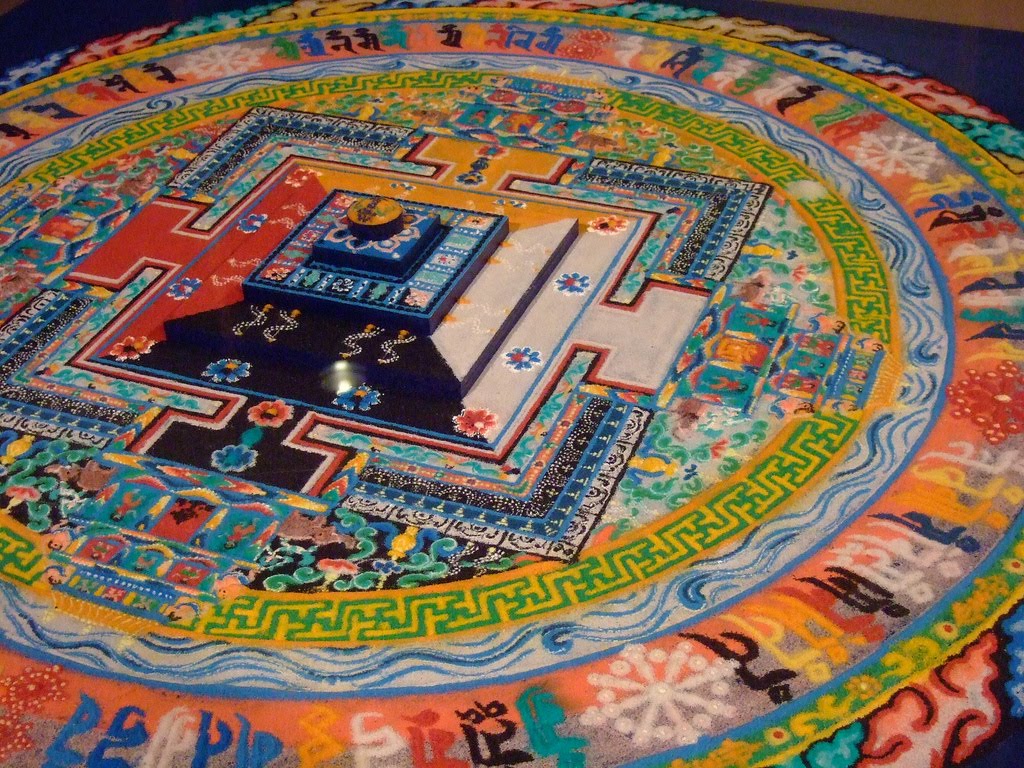
I recently rented a documentary on Buddhist practices and rituals by Werner Herzog entitled Wheel of Time. The film focused on the Kālacakra Initiation which took place in Bodhgaya, India in 2002, the place where the Buddha attained enlightenment. Kālacakra centers around the building of a beautiful sand mandala which is made entirely by hand by skilled monks. Here is a chart breakdown of the elements in a Kālacakra mandala and a video depicting the 3D image that this 2D image represents.

[Image of a sand mandala, taken from We Can Change the World.]

I found the Kālacakra Initiation, which initiates practitioners into Vajrayana Buddhism, fascinating although I'm unfamiliar with their rituals and, quite honestly, Buddhism altogether. Yet hundreds of thousands of Buddhists came not only to get initiated into the Vajrayana practices but to see the Dalai Lama who leads the initiates through the ceremony. This ritual is meant to activate the seed of enlightenment and help the initiate onto the path towards buddhahood. Some came by prostrating themselves the entire trip. One such pilgrim, Lama Lhundup Woeser, traveled in prostration for over 3,000 miles which took him three and a half years to complete. Word spread quickly of his journey although he didn't want any attention, and because of his dialect the film crew needed two different translators because he came from such a remote village. Monks held theological debates while others prostrated themselves towards the Sri Maha Bodhi, the bodhi tree claimed to be the descendant of the tree under which the Buddha attained enlightenment. Many of those prostrating towards the tree had a goal of prostrating over 100,000 times which usually takes them up to 6 weeks.

It is a beautiful film and I highly recommend it to anyone interested in Buddhism. It doesn't get into much detail but it is worth checking out. But through all the rituals and chants the thing which moved me the most were the human moments. Watching thousands of people chanting and meditating you almost forget that they still feel pain and suffering, love and compassion. There was one scene were it looked like the monks were throwing out food or gifts out into the crowd (it looked like candy bars) and people were scrambling like mad. Another scene showed monks rushing to get the chance to work in the kitchen to feed their brothers. And as the Dalai Lama announced he was too ill to lead the main initiation rites announcing the cancellation and postponing of the Kālacakra initiation, you could see the Dalai Lama holding back tears of pain for all those who've traveled hundreds even thousands of miles to attend.

The rituals were concluded later that year in Austria as the monks rebuilt, consecrated, meditated upon, and finally dismantled the sand mandala. The mandala is then thrown into a nearby river to show the impermanence of all things created where it will flow out into the world as a blessing to all. And yet it wasn't the rituals and ceremony which stuck with me after the film was over, it was the human moments: the smiles, the laughter, the tears (of joy and sorrow), the acts of compassion, and just simply being with your fellow man. There is a short interview with the Dalai Lama who speaks about Mount Kailash being the center of the universe. He goes on to say that each of us are equally the center of the universe. At first this seemed odd to me coming from the Dalai Lama but what I think he meant was if we are all the center and we acknowledge each other as the center, acknowledge each others equality (and our potential Buddhahood), then our reasons for "one-uping" our fellow man begin to dissipate as we realize our relationship and interconnection with our neighbor.

Wednesday, April 28, 2010

PBS- The Buddha

PBS aired a new documentary on the Buddha, narrated by Richard Gere, earlier this month and I missed it the first time around. Luckily someone has posted the entire 2 hour program on Youtube. So if you're interested watch it while it's still available. I'm sure PBS will serve a take down notice to Youtube soon so it won't be up for long.


The Buddha is the first of three religious documentaries which will air this year, the other two being God in America (airing in October) which I wrote briefly upon last week and The Calling (To be announced) a documentary following Muslim, Christian, and Jewish Americans who decided to enter the clergy. I love religious documentaries, especially those which encourages inter and intra faith dialog. Of course if you happen to miss any of these you can always purchase them at the PBS store.

Thursday, April 22, 2010

PBS- God In America

PBS to air new 6 hour documentary this fall entitled God in America. The program will air over a span of three nights on October 11, 12, and 13 covering the history and impact of faith on the American landscape.


[If this trailer gets taken down by PBS you can also see it here along with more information on the program.]
In my opinion, PBS has always done well on documentaries dealing with religion (I was set to see the Buddha but unfortunately had DVR issues and lost the recording). And from what I could tell from the trailer what they mean to cover is the collective faith of Americans and not exclusively America as a Christian nation, as Palin and friends have convinced themselves has always been since our Deist...err, I mean "Christian" slave-owning founders. I'm sure they'll cover the faith and beliefs of the founding fathers but I'm hoping they'll mention historical revisionism and the heroic painting of the Fathers as Bible-thumpin' Christians. I'm also excited to see that the program will also include Atheism and the growing Spiritual but Not Religious along with the political brawls over separation of Church and State.

What do we mean when we talk about God in America? There are many (see links above) who believe that the words 'God', 'faith', and 'religion' exclusively talk about Christianity, as if the words were interchangeable. Sorry kids, they're not. The problem with this narrow mentality is that if the nation were to accept prayer in school they would have to accept ALL forms of prayer in school (see link above). The fundamentalists would rejoice in the streets until their children come home from school chanting 'gate gate pāragate pārasaṃgate bodhi svāhā'.

Parents: "Jason, where did you learn that demonic prayer."
Jason: "From my new friend at school. He's a Buddhist."
Parents: Gasp!

You can't have your cake and eat it too.

The issue of government funds supporting religious groups (and not to forget the Intelligent Design textbooks poorly disguised as science) is that it would have to be all or nothing. This was the issue the founders of the country faced: to discourage the elevation of any ONE group over the rest preventing the fracture of our diverse nation. Faith is integral in the lives of many Americans BUT when we enter into the public square we can not bludgeon everyone else with our faith, nor should we feel our faith suppressed in the public square (which it's not, especially if you're part of the majority faith. There is no such thing as "Christian persecution" in the States. You want to experience persecution, then go talk to the Arab Christians in the Middle East.). Jon Meacham's book, American Gospel: God, the Founding Fathers, and the Making of a Nation is an excellent source which covers the struggle to create a religiously (but not spiritually) neutral public square. I highly recommend it to everyone, especially those who think the founding fathers were born-again Christians.

Returning to the topic, I hope God in America has time to cover the future of the American religious and spiritual landscape. Even with all of the current religious turmoil in the political and social arenas I feel we as a nation are slowly crawling out of the enveloping darkness of religious tribalism into a new era of enlightenment. Religious historian and author, Karen Armstrong states that we are currently in the second Axial Age, spanning from the era of Enlightenment to today. I don't believe we will ever collectively put spirituality behind us, nor do I think religion is leaving anytime soon (sorry Sam Harris). I don't buy into organized religion but I don't think that religion should disappear, we just need to rediscover our shared humanity. Can we remain religious as members of a 21st century society? Maybe, maybe not, either way there's a lot of baggage we'll have to leave behind.


Oh by the way, for you Lost fans, did you notice Michael Emerson in the trailer banishing someone from a Puritan colony?

Saturday, March 13, 2010

Trembling before G-d

"How can you be queer and orthodox at the same time. I see a logical contradiction ...in order to maintain my sanity and my selfhood I had to leave, I had to rebel."
~Israel Fishman, a homosexual Jew living in Brooklyn.
I recently got a chance to watch Trembling Before G-d, a 2001 documentary on homosexual orthodox Jews. What? A homosexual orthodox Jew? I felt completely foolish for thinking that such a thing never existed because I've never really thought about it. But just because we don't think about it doesn't mean that people don't suffer through it daily. The film interviews several homosexuals living within orthodox Jewish communities around the world many remaining behind silhouettes for fear of being ostracized by their friends and family.


When it comes to Christianity, I'm assuming most homosexuals either leave the church or join a more liberal open-minded church to keep their sense of community. But this doesn't work the same within Judaism, which still has liberal communities, because Judaism is more about what you do than what you believe. The gays interviewed in the film want to retain both aspects of their identity: their Jewish orthodox roots and their homosexuality. They struggle to keep both without losing their sanity, and it's painful watch. I can't imagine people still think homosexuals are choosing to be who they are, choosing to "sin" and be apart from G-d while inflicting an enormous amount of pain on themselves. Homophobic Christians believe gays are living apart from G-d because "true Christians" would have faith to pull through their homosexuality, or as some would say, "pray the gay away". Celibacy is also encouraged as an alternative by a few of the orthodox Rabbis who genuinely want to help gays within their community, but struggle themselves to understand what G-d is telling them. The difference between conservative Christians and Orthodox Jews is that a homosexual Jew is still a Jew regardless of their beliefs because they are connected as a community through their actions. I can not identity with either Judaism or homosexuality but I can identify with pain and suffering. All these people want is to be accepted and remain loved. There was one scene where a 50 year old homosexual man, Israel Fishman, says that all he wanted was his daddy. That completely shattered my heart to pieces. I mean I began bawling big man tears. All they ask for is love, so why is it so hard to give? Because the community is affected by it and blaming the homosexual is an easier way out than wrestling with it. I highly recommend this film. If you have a Netflix account it is available as an online stream and can be viewed on your computer. It is also available in its entirety on Hulu with limited commercial interruptions. It's available on Amazon, for a small price, if you feel uncomfortable watching it on Hulu (which you shouldn't, Hulu's completely legit).